 ModeOfLife Become love as God exhorts us, for this is the true starting point for changing your life and the world. For it is love that will bring respect, justice and equity into the world, not our personal opinion of what justice or equity is.
For over a decade, Fr. Luke and Presbytera Faith Veronis served as Orthodox missionaries in
Albania under the spiritual leadership of Archbishop Anastasios (Yannoulatos), with Fr. Luke
directing the Holy Resurrection Theological Seminary in Durres. The Veronis family has now
returned to the U.S., where Fr. Luke pastors Sts. Constantine and Helen Greek Orthodox
Church in Webster, Massachusetts, and is Adjunct Professor of Missiology at Holy Cross
Greek Orthodox Theological School and St. Vladimir’s Seminary. Below, Fr. Luke offers an invigorating
account of life in the mission field and what it takes to be a long-term missionary.
RTE: Father Luke, what makes a good missionary?
 FR. LUKE: Something obvious but central, and that is love. I once spoke with
an old Greek monk, Fr. Antonios, from St. John the Forerunner Monastery
in Kareas, near Athens. The Kareas Monastery has sent out missionary-nuns
for over twenty years and when he came to Albania, I asked him, “Give me
some advice on being a good missionary. What should I remember from
you?” He said, “If you remember this you will do well. Do everything in love,
for love, and by love. If you do this, you will be a great missionary.” This
sounds simplistic but it is absolutely central to what a true missionary wants
to be. Everything that you do when you are trying to adapt to a culture, struggling
to learn a language, or understand a people, you do out of love for them.
One of the first things a missionary must do is to learn the language, no
matter how hard it is. This is a sign of love for the people, a sign that you
respect the dignity of their culture, and this respect must be communicated
before you ever proclaim the gospel. His Beatitude, Archbishop Anastasios
of Albania says that when you go into a country, you keep whatever is good
in the culture, even if it is different from the way you do things. Anything
that is completely incompatible with the gospel you have to reject, but there
are many things that can be baptized and given new meaning.
Also, you need to enter the mission field with extreme humility. You are
not going to “save” these people, and you are not going simply to teach. First
and foremost, you are going as an ambassador of God’s love, to offer a
witness of His love in concrete ways. Your emphasis should be, “I’m on a
journey – let me show you where I am going, and if you are interested, join
me on this journey.” I may be leading the journey for part of the way but
there are going to be times when the indigenous Christians will lead me; I
will be learning from them, even about spiritual life. We are taking each
other’s hands and walking towards the
 Kingdom of God. This is extremely
important because too often I see western
missionaries come with extreme arrogance,
ignorant of the culture they are
entering and uninterested in learning
about it. They are arrogant in thinking
that they are bringing the gospel for the
first time, as if they are the saviour. They
forget that Jesus Christ is the Saviour;
we are simply His ambassadors. We must
always remember that we are still working out our own salvation, but along
the way we can invite others to join us on this journey, to travel together.

Archbishop Anastasios gives a great example when he says about himself,
“I am simply a candle that is lit in front of an icon. I shine so that people can
see the icon. One day my candle will be snuffed out. When my candle goes
out, someone else will have to come and let their light shine before the icon.
The important thing is the icon, not the candlelight.”

My suggestion for new missionaries is to spend the first year just learning
the language, the culture, the ways of the people, and not focus too much
on preaching the gospel. Of course, you preach first and foremost with
your life. Francis of Assisi once said, “Preach the gospel at all times,
and if necessary, use words.” By focusing on the language, culture and
individuals, you show that you are interested in them as people, not solely
in making them converts.

RTE: In your book, Missionaries, Monks, and Martyrs,[1] you included St.
Macarius (Gloukharev) of Altai, who is a fascinating example of preaching
with one’s life. He went to a remote part of Siberia, where he taught in village
after village, with no success. After years of fruitless labor, he left and returned
later to go at it differently, through active service with homeopathic medicines
and simple offers of help. Only then, was his gospel message received.

FR. LUKE: The example of St. Macarius raises an important question all
missionaries must ask: “What is success?” Particularly in the West, where
we are so number conscious, we want to show masses of people coming into
the Church. In some cases, that happens. In Tirana, the capital of Albania,
20,000 – 30,000 people gather in the main boulevard for the Resurrection
Service on Pascha night to hear the archbishop offer his homily, and sing
“Christ is Risen.” This may seem like a great “success,” but we shouldn’t be
fooled by numbers. There are other missionaries who struggle like
St. Macarius did, who work in Muslim lands and other difficult societies.
They are never going to show great numbers; they may only have handfuls
of people who come to Christ. Are they unsuccessful? Surely not. Are they
unfruitful? No. They are being faithful to God, and faithfulness to God is the
determining factor of success, not numbers. Our job is to be as faithful as we
can in offering a pure, authentic witness of His love.

Another aspect that is extremely important for missionaries in the field is
to identify as best they can with the people, to live at the level of the indigenous
people. Now, this isn’t always possible. We from the West may give up
a lot of our comforts and live at a level far lower than in our home country,
but still live far above their means. We have to struggle with this, and like
many things in our faith, we have to live in the tension between the goal and
what we can actually do. Constant effort and growth are the keys.

I remember asking Archbishop Anastasios what he considered his greatest
contribution to the mission field – and we know that he has made many
significant contributions as a churchman, a hierarch, a professor at the
University of Athens, a missiologist, and as a missionary. Reflecting on his
achievements, he said, “I feel that the greatest contribution I’ve made in
Africa and in Albania is that I’ve lived among the people and tried to identify
with them.” In Africa, he traveled to the most remote, poverty-stricken
communities, visiting and encouraging people. In Albania, he flies by
helicopter to inaccessible villages far up in the mountains. He wants to
be close to his flock, and he always feels at ease with everyone. More importantly,
the people are at ease with him, and see him as someone who loves
and identifies with them.

When Albania fell into anarchy in 1997, the army storage facilities were
broken into and the anarchists stole machine guns and hand arms. You
could buy a Kalashnikov on the street for five dollars, and little kids were
shooting Kalashnikovs into the air outside my apartment and all over the
city. Total anarchy reigned throughout the country, and the embassies
began evacuating their citizens. Almost every foreigner left. Although the
archbishop is Greek, and could have been evacuated with the Greek
Embassy, the thought never crossed his mind. He was the archbishop, and
he had to stay with his people. I also stayed, along with a handful of other
missionaries. We wondered
how we would protect the
archbishop if armed bandits
broke into the archdiocese
– and we were pretty
sure this would happen. We
watched one day, as ten
armed and masked men
broke into and looted an
electronics store across the
street. We expected the
same thing to happen to us.

People often ask us if we
considered leaving with those who were evacuated. To be honest, we didn’t.
We understood what a terrible message this would give. People would
think, “Look at these missionaries. At the first sign of danger, they abandon
us.” We had to show them that we would stay with them in times of danger,
in the midst of anarchy and chaos. We were one with them, and the love of
God knows no bounds! We may never be able to identify completely with
the indigenous people, but we must show them, as much as possible,
“We are with you!”

I remember another story of the archbishop’s that exemplifies this
 missionary outlook. When Archbishop Anastasios was archbishop of east
Africa, he often served in simple village churches with mud walls, tin roofs,
and paper icons on the mud iconostasis. In the early 1980’s he was invited
to attend a conference in Leningrad, and for the Sunday liturgy, he served in
one of the beautiful Russian cathedrals, perhaps St. Isaac’s.

He celebrated
liturgy surrounded by magnificence, and he began to wonder, “Where is
God? In the midst of this opulence, or in the little mud chapel in Africa?”

So
when it came time to preach the sermon he raised this question: “Is God in
 the mud churches of Africa with their paper icons, or is He in these magnificent
cathedrals in Russia?” When he asked this, the translator was a little
embarrassed to repeat the question, but Fr. Anastasy continued, “As I travel
throughout the world and worship in many different types of church
structures, I understand that God is wherever the Eucharist is. He is in both
the mud churches of Africa and the beautiful cathedrals of Russia.
RTE: Also, these cathedrals were built with sacrifice and love by thousands
of people, rich and poor, who wanted to give the best they had to beautify
God’s house.
FR. LUKE: Right, and the point is that we have to feel comfortable everywhere,
and realize that Christ works everywhere. It is not our role to judge,
but to offer a witness for Christ.

Adapting to a New Culture
FR. LUKE: Different people have different ideas of what mission is about.
Some think that it is a romantic adventure, and it’s true that there is excitement
and adventure to mission, especially in the initial stages. Once one
enters the mission field and begins to live the daily life, trying to proclaim the
gospel among people who aren’t always open or interested, the romanticism
quickly disappears. This is a stage of frustration that many missionaries
experience. The missionary has to work through this, but once he does, he is
ready to begin serious missionary work. He understands that an authentic
mission requires a commitment that is greater than any frustration or
obstacle, a commitment that demands time, effort, and sacrifice.

During our first years in Albania, the Church faced a major crisis. The
government was trying to kick the archbishop out of the country and we
were afraid that the foundation he had built for the Church’s work might be
destroyed. When I voiced my worries, the archbishop said, “Fr. Luke, you
have to remember something. Albania, under the worst form of communism
and as the only totally atheistic state in the world, was a stronghold of Satan
for almost fifty years. Now that democracy has come, don’t think that Satan
is simply going to lie down and let the gospel be proclaimed. We are not
fighting against flesh and blood, but against the principalities and powers of
darkness, and this means that it’s going to be hard, that there is going to be
suffering, that there are going to be casualties. We have to be ready for this.”

If you want to follow the Christian life, it’s the same thing. Missionary life
is a life of the Cross, a life of sacrifice, of humble service, and of not always
being appreciated. The archbishop told me that the missionary must be
ready to be crucified by the very people he is trying to help. We can’t be
devastated when this happens.

RTE: I imagine that the initial period of missionary enthusiasm is very
similar to what new Christians go through. I remember once wishing aloud
that a warmly enthusiastic new convert would come down to earth, but a
Russian friend said, “Oh no. This is his spiritual childhood. Don’t deprive
him of it. He will never be so innocently happy in his Christian life again. He
will discover the difficulties and troubles of our earthly Church soon enough,
but for now God has given him this heavenly joy. It will come to a natural end
at the right time, and then he will struggle.” I think she was right. But once
the struggle begins, how do you help new missionaries adapt?

FR. LUKE: There is a typical pattern that missionaries go through. As I said,
in the initial excitement of entering a new culture, seeing new people and
new ways of doing things, there is warm enthusiasm, “Ah, these people
are wonderful….”
For example, on my own first short-term trip to Africa, I lived in a village
for a month. I saw Kenyans walking an hour to church, and then sitting in
church for four hours with no desire to leave quickly. To an outsider they
seem so joyful and faithful that you generalize and say, “These people are
just wonderful.” After you’ve been in the culture a little longer, however, you
start to see the other side: “OK, some of these people are faithful, pious
Christians … but there are also people hanging around to get something
material from the church, who aren’t so honest or sincere.”

Usually by the fifth or sixth month in the mission field the pendulum
starts to swing back and the missionary begins to see things with a negative
eye. This is the most dangerous time. I’ve seen missionaries so disillusioned
that they leave the mission field – or perhaps they don’t leave, but they allow
their disillusionment to darken their entire experience. They view everything
and everyone from a negative perspective. If this happens, it’s a
tragedy, and it’s better for the missionary to leave than to offer such a
distorted view of the gospel.

It is important to prepare missionaries for these two stages, and there is
still another phase which any good missionary will eventually reach. In this
third stage, the missionary sees both good and bad within the culture. In any
culture, including our own, we realize that there are faithful, pious people,
as well as con-artists and those who are insincere. There are also good
people who are weak, and who may fall into temptation. This is the reality.

RTE: Of life on earth.
FR. LUKE: Exactly, of everywhere. We can’t go on mission expecting to find
people open and ready to embrace the gospel. It is important to challenge
the cross-cultural worker to adapt as soon as possible, but not to go native,
not to give up his old culture in trying to blindly embrace the new. This is
dangerous. When you become a missionary you become a person without a
home. Although you have left your own culture, you will never fully adapt
to the new. The indigenous people will never truly see you as one of themselves,
no matter how hard you try. You become a third culture person.

Another common mistake in the history of western Christians has been
for the missionary to create a western compound, a small western society in
the midst of a new culture. When you leave that compound in the morning
you enter the local culture, but when you come back at night, everything is
like it is at home. This should not be the goal. We must strive to live among
the people, close to the people.
RTE: St. Macarius of Altai found that if he left the new Altai Christians in their
villages, they would inevitably be drawn back into unchristian practices. The
pull of society was just too great. So he created new Christian villages within
the society, and asked the Christians he baptized to live there. The Spanish
missionaries in California did the same thing. What do you think of this?
 FR. LUKE: There are pros and cons to these different methods. There is
validity to pulling people out of their culture and trying to create a village of
new believers, and something positive in trying to avoid temptations which
may be too strong for a neophyte Christian. A danger in pulling indigenous
people out of their cultural setting is that they may also lose their connection
with the people they left behind.
RTE: Also, I imagine that they would become dependent on the missionary
who is the inspiration for the village.
FR. LUKE: Yes, and to some degree they may be tempted to adopt the
missionary’s cultural baggage, whether western or whatever, and then it is
hard for them to be salt for their own society. Along the same line of
thought, another danger that missionary agencies have realized for
centuries is that if you take the indigenous Christian out of his home setting
and send him to the missionary country for training or for seminary, after
he has lived in another culture for four or five years, he adapts to that
culture and can’t really fit into his own again. His own people will see him
as a foreigner if he goes back – and many don’t return at all.

RTE: We are speaking of missionaries going into a new culture, but there are
other types of missionaries as well – like the Greek St. Cosmas of Aitolia,
who didn’t settle in any one place but traveled throughout Greece and
modern-day Albania, preaching to both Christians and Moslems. Another is
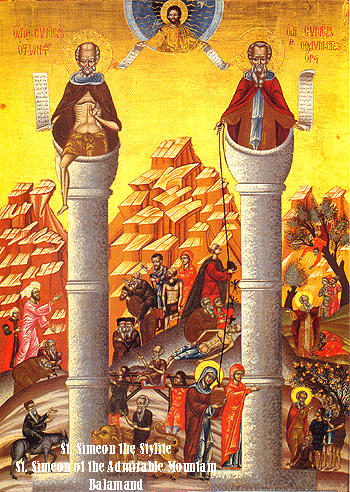
 St. Symeon the Stylite, who didn’t go anywhere. People came to him on his
pillar from as far south as the Arabian peninsula – not only for spiritual help
but for prayers for failed crops, for drastic weather. Arab tribes came to have
him adjudicate their differences, and westerners came also, from Paris,
Rome, and Britain.
FR. LUKE: In our Orthodox tradition we have the outward-reaching evangelical
missionary efforts of St. Paul, Sts. Cyril and Methodius, and St. Innocent
of Alaska, but then we also have the example of monastics who settled in an
area to cultivate their spiritual life, reached a high level of sanctity, and
eventually shone forth and attracted people with a centrifugal force.
RTE: Like the candle in
front of the icon – so
bright that everyone
came to see what it was.

FR. LUKE: Yes. And both
are necessary. One of the
great dangers in our
Church is that I sometimes
hear people say,
“This ideal of a holy man
settling in an area and
attracting people to
himself – this is true Orthodoxy. This is our only form of mission.” This is
totally inaccurate. Yes, one can certainly see this silent witness through the
centuries, but simultaneously, we had missionaries consciously reaching out,
crossing cultures, going to other places. From the fourth century on, we have
numerous examples of monks not only going into the desert to retreat from
society, but also settling close to pagan villages and purposefully joining other
monastics in organized bands to proclaim the gospel.

Long and Short-Term Missions
RTE: Can you tell us what it takes to be a long-term missionary? You’ve
spoken of the beginning stages, how about later?
FR. LUKE: Archbishop Anastasios has good advice for people thinking of
going into the mission field: “It’s always better to say you are going for one
year and stay for ten, than to say, ‘I am going for ten years,’ and after the
initial enthusiasm fades away, you realize you can’t handle it.” There is
wisdom in this: go step-by-step, and God will give you grace and strength.

In my early 20’s, when I attended Pennsylvania State University, I contemplated
entering the Peace Corps. When I learned more about it though,
I was afraid, because I wasn’t sure I could handle the two-year commitment
to leave my country and live in an impoverished third-world village.
I turned down the opportunity, but God in His own way took me step-by step.
He didn’t reveal to me, “In the future you will spend ten years in
Albania.” No. First, I went on a short-term mission team for one month to
Kenya. The following year I returned for a six-month commitment, and
these six months turned into a year of service. After returning to Africa
three times over the next four years, I began looking at Albania as a place
where I could serve as a long-term missionary. I suggested to my wife, “Let’s
make a three year commitment, and then see.” God took us through those
three years and gave us the strength we needed. Those three years turned
into five years, seven years, a decade. We might have been frightened, had
we known at the beginning that we would serve in Albania for ten years, but
God took us by the hand and led us.

Don’t frighten yourself by thinking, “How can I become a missionary and
live in another culture for so many years?” Just go, make the sign of the
cross, and start working. Be open and willing to stay for longer, but tell
yourself, “I am going for one year or for two years, and see how it works.”
But keep praying, “Lord, if You give me the grace, I will stay as long as You
want me here.”

RTE: You mentioned the short-term mission teams of two or three weeks.
I imagine that it’s helpful for people in a foreign country to feel that others
appreciate them enough to come, but what are the real benefits of this
short-term experience?
FR. LUKE: One has to be very clear about the purpose of missions. The goal of
missions is to establish an authentic Eucharistic worshipping community in
the people’s own language and culture. If one is going to serve in a place that
isn’t yet Christian, this will take many years and involve great effort, sacrifice,
and struggle. To achieve anything, the missionary must commit himself to
living among the people long-term and learning the language and culture.
With the ease of travel and technology, a new phenomenon has arisen in the
 past thirty years in the mission field – “short-term mission teams” – which
send people for a week or two, or a month, to a certain area. They often have
a specific project: to build a church, run a catechetical program, etc. There is
value in these short-term projects, and the first and greatest value is for those
who are going. It exposes them to a different culture, a different people.
For westerners it is often the first time they’ve seen a third-world country up
close, with of all its poverty and hardship. It’s an eye-opening experience.
For many, this initial experience is an exciting adventure, and although
these short-termers go with the intention of offering something, they receive
much more than they can offer, and usually return to their home country full
of enthusiasm. They often become ambassadors for the missionary movement;
they speak in churches and their enthusiasm is contagious. It’s great
for them and for the church that sent them. But what did they really offer
for the week, or month, or two months they were in the mission field?
They offered something. Perhaps they built a building – but I’m sure the
indigenous people could have built the building themselves if they’d had the
money. Perhaps they created some nice friendships, and that’s important to
encourage people, but they have to realize that what they offered was very
limited. It is not going to transform, convert, and change people’s lives.
At best it is going to complement the work that’s already being done by
the long-term missionaries and the local Christians who live there.

Some churches are
now sending many
short-term teams;
you can get the people,
they’re enthusiastic,
it motivates
people back home.
But people are still
afraid to go into long-
term mission and this
“short-term” trend
can create a great
danger for the future.
Short-term teams are not the goal of missions, but they can support the overall
effort, and short-termers need to be challenged as to where they are going
to take this experience when they return home. In any group of twenty short-
term missionaries who go somewhere for a month, my goal would be that at
least one or two of them seriously consider long-term mission work.

For others, hopefully, this incredible experience will help to transform
them into more serious Christians. Lord willing, they will use this experience
as a stepping stone in their own spiritual journey. Perhaps they won’t
become long-term missionaries, but they will be more dedicated Christians
in whatever they do. Hopefully, the majority of people who go will at least
understand missions in a new way, and even if they never become long-
term missionaries, they will become supporters and partners of those in
long-term missions.

There are two results we don’t want from short-term missions. First, we
don’t want these participants to think that they are missionaries who have
fulfilled their responsibility in missions. They are not missionaries, but
members of a missions team. They now have a responsibility to use the
experience they’ve received for the glory of God and to spread the spirit of
missions in the Church. The second danger is that we don’t want short-term
participants to return home and, after an initial month of excitement, put
the experience away as a great adventure and go on with their life as they
lived it before. We would consider both of these results as a failure in our
short-term strategy.

I have participated on five short-term mission teams, four times as a
leader. I have also received five short-term teams while being a long-term
missionary. So I’ve been exposed to this concept of missions from a variety
of angles. These short-term experiences radically changed the direction of
my life, so I’m very grateful for the experience. They exposed me to the reality
of missions work and led me to longer stays in Africa. Such trips filled
me with enthusiasm and zeal for missions, and led me to eventually study
theology at Holy Cross Greek Orthodox School of Theology, as well as to
study missiology at Fuller Seminary’s School of World Missions.

When I was a long-term missionary receiving missions teams, I did all the
prep work for the teams, and it took a month out of my schedule each time
to accommodate them. In certain cases it was worth it. Some teams did great
and really complemented the ministries we were already doing. But to be
honest, other teams were very demanding and in the end, the benefit that
they offered was minimal. In those instances, it became a very time-consuming
project that didn’t have a lot of value for our overall mission. Short-
termers need to be aware of this, and when they go, to be humble about it.
RTE: I imagine they are more like pilgrims than missionaries, guests of
Orthodox missions who may be able to help out in a small way.
FR. LUKE: Yes, I always tell the short-termers that they shouldn’t call
themselves missionaries. They aren’t missionaries. They should think of
themselves as visitors to a mission field. Some don’t like to hear this.
They would like to think, “I’m following the path of the great missionaries;
I’m a missionary now.” That’s quite naive.

Families on Mission
RTE: How has it been having your family in the mission field?
FR. LUKE: When my wife and I first went to Albania, many people thought
that it was going to be very dangerous and that our children would suffer:
“You are going to deprive your children of all the benefits of life in
America.” Contrary to that expectation, we feel that our three children who
were raised in the mission field were immensely blessed by the experience
of learning another culture and language. They always appreciated what
they had in America when they went back, but they also appreciated their
mission home in Albania, which they thought of as their “real” home.
They’ve grown up with a very different world-view. They appreciate
things that they would never think twice about if they had grown up in
America. During our first years in Albania, we didn’t have running water
every day. So, the kids learned to appreciate it. When we had water, we’d
say, “Thank God for water. It’s great to have it.” During different periods,
for months at a time, the electricity is off about five hours a day; in winter,
maybe seven or eight hours. So they got excited when the electricity came
on. Or, if we did have electricity, the tension was often so low that we couldn’t
do something as simple as watch a video. I remember on one of our visits to
the U.S., they wanted to watch a video, and came to my wife saying,
“Mommy, if there’s enough tension can we watch television?” They still flip
the switch to see if the electricity is working.

Next to our house in Albania we had a very tiny shop, nine by fifteen feet,
with all different types of food – this was where we did most of our shopping.
Once, when we were about to go back to America, my son Paul asked his mother,
“In America, will they have shops as big as Uncle Soorie’s?” We laughed. It
was beautiful to see how they were exposed to a different way of life.
We lived in Tirana, the capital of Albania, and we were constantly exposed
to beggars, poor people who came to our house every day asking for help. It
was wonderful for our children to see this, day in and day out. They got used
to getting things for the beggars, answering the door and coming and saying,
“Oh, so-and-so is here.” We got to know these people by name, we visited
their homes. When you live in suburban America you aren’t even exposed to
them unless you go downtown. Many of these beggars truly became friends,
and our kids loved them. They loved playing with them and saw them as
human beings, not as beggars.

Another blessing of raising children in the mission field is community,
both the indigenous Albanian community, the wonderful local people that
were part of our life, and our co-missionaries who themselves had numerous
children. At one time we had fifteen missionary children in the field, and
they created such bonds of love and friendship. They weren’t exposed to the
busyness, to the constant activities that American children are involved in.
Their lives were very simple, and very fulfilled.

Neither my wife nor I have any sense of their being deprived, and one of
our greatest regrets in leaving Albania after ten and a half years is that we
have left at a time when our children are still young, and we are not sure how
much they will remember. We often talk about going back into missions when
they are a little older so that they not only remember, but can participate more
fully. Even though they were young, we tried to get the idea across that they
themselves were missionaries, that they needed to be witnesses. To whatever
degree they could participate in our different activities, they did.

RTE: Growing up with cultural diversity must not only teach what is universal
in human nature, but how to deal with differences early on.
FR. LUKE: Right. We Americans, unfortunately, are quite isolated from the
rest of the world. The universal business language is English, so we think we
can get anywhere speaking English. Having only Canada to the north and
Mexico in the south, we aren’t exposed to many different cultures and
 languages and this is a great loss for us. It’s so enriching to be around the
diversity found in a mission field, and to learn to see beauty in such diversity.
One thing I tried to get across to the Kenyans, and later to the
Albanians, was, “Sure, in America we have things that are nicer than in
Kenya or Albania, but you have many aspects of your culture and life that
we Americans can envy. Family connectedness, the support you have for
one another, hospitality – how beautiful these things are! Don’t ever lose
these aspects of your culture and think, ‘We want to become western, or
American, because America is better in everything.’ There are certain things
you can adopt from America that are beautiful, but don’t lose the beauty
and richness that you have in your own tradition.”
Hospitality was something that always left the greatest imprint on me.
I could travel to the poorest village in Africa and they would put on a feast.
It was their responsibility to show love and hospitality to guests. It is the
same in Albania. I don’t know who is more hospitable, the Albanians or the
Kenyans, but they would put anyone in the West to total shame. Having
almost nothing, they share whatever they have with whoever comes.

RTE: An American seminarian at Holy Cross Seminary told me about a
depressed acquaintance who called one night, feeling suicidal. The seminarian
invited him to come to the seminary for a few days for a change of
scene and to be in a calm atmosphere. He agreed and the seminarian made
the arrangements and cleaned an empty dorm room so that he could have
his own space. The day his friend moved in, one of the Greek-born seminarians
found out what was happening and insisted that the man take his
own room, which contained his books and belongings, icons that were
prayed in front of, and was a real home. The Greek seminarian slept in the
hall on a couch outside the door so he could check on him through the night.
The American seminarian said, “You know, I was so pleased that I’d found
him his own space where he could have some privacy, where he could put
his own things up – but actually what he needed was to be taken into someone
else’s home and taken care of. I didn’t get it until I saw it.”

FR. LUKE: Yes, this virtue of hospitality is something missing in our
American way of life. As missionaries, my wife and I saw hospitality as
one of the greatest ways to express God’s love to the people. We wanted
 our home to always be open to
people. We married right at the
beginning of our time in
Albania and it is interesting to
think that my wife and I slept
in our house alone perhaps
three months out of the first
five years of our marriage. We
always had people coming,
numerous people staying for
months at a time. Our open
home was a hallmark of our
ministry. Even after the
children started coming and we didn’t have as many overnight guests, we
always had an open-door policy. There were people at our house every day.
One of the difficult counter-cultural adjustments in coming back to America
on sabbatical was that although we lived on campus at a seminary, no one
came to visit. We lived there for four months and maybe a handful of people
came to our house. And even when people came, they’d say, “I’m just here for
a minute, I’ve got to run…” They’d stay briefly and then go on with their day.
Single Missionaries

RTE: We’ve been speaking here of missionary families. What opportunities
are there for unmarried men and women? And in view of cultural differences,
are single women limited as missionaries? What part do they play on
a mission team?
FR. LUKE: The mission in Albania offers a good response to this question.
During the years I served there, of the 20-25 missionaries we had at any
one time, we had a nice mix – usually about eight monastics, eight
married missionaries, and six or seven single missionaries. Of the two
dozen missionaries, about half were men and half were women. Also, about
eight were clergy, and the rest laity.
The unmarried missionaries played an important role in the overall outreach
of the Church. In Albania, we had single missionaries who headed up
our medical clinic, our elementary school, our post-secondary professional
institute, as well as our development and emergency relief office. We also
had single missionaries who taught at our seminary, who taught English in
a variety of contexts, taught catechism, worked in administration, and who
participated in our university ministry, among other things.

The Body of Christ has a need for everyone – men or women, married or
unmarried. It is the same for the mission field. In fact, when a missionary
team has a variety of members, it makes the overall witness that much more
effective. Some people will relate well to a monastic. Others feel more
comfortable with a married priest. Some prefer to approach a mother, or a
married woman. Still others will listen to a single man or woman. All are
part of one body, offering a unified witness. So there are surely opportunities
for the monastics, the married, and the unmarried!
In some countries, it isn’t appropriate for men to approach women and
talk with them in public. Such societies need women missionaries, and this
means both married and single women.
 In the Protestant world of missions, single women really weren’t encouraged,
or even allowed, in the mission field until the 1800’s. By the 1900’s, women
outnumbered men as missionaries. Today, women far outnumber men, and
this includes many single women. Women had to overcome many obstacles
and prejudices before being allowed to serve in a variety of capacities, and this
may be the same for the modern Orthodox missionary movement.
RTE: Do you have any specific counsel for unmarried missionaries?
FR. LUKE: My advice for single men or women is that they must be ready for
some additional challenges. The loneliness of a new culture, the challenges
of entering a new country, the frustrations of learning a language, and the
normal difficulties and disappointments of the mission field can be
overwhelming. As a married missionary, you have your spouse to support
and comfort you; the monastics may be living in community and have
another type of support; but the single missionary can feel the loneliness
and frustration in a magnified manner. A single person has to be ready for
these added challenges. He or she needs to be a strong person, and also be
able to find support in time of need. Their co-missionaries need to be sensitive
to this extra burden, and try to reach out to them.

One way to help overcome these additional struggles would be for single
missionaries to live in community, either with other missionaries of the
same sex, one of the missionary families, or even with an indigenous family.
Living with a family of the country can be one of the fastest ways to learn the
language, culture, and ways of the host country. Of course, other
challenges may arise as cultures clash and one’s privacy may be lost.
Co-Workers and Community
RTE: I imagine that another challenge is not only learning to live with
the indigenous people, but with your co-workers and with the bishops and
higher clergy over you. I’ve heard of very good missionary situations that deteriorated
quickly with a change of administration, and, conversely, mediocre
situations that were enlivened and made fruitful by good incoming leaders.
FR. LUKE: That’s related to another aspect of missions. Do you know the
number one reason why missionaries leave the field? It is quite interesting.
The most frequent reason is because of conflicts with other missionaries. It
is not because of difficulties they face in the culture, learning the language,
or preaching the gospel to unresponsive people. No. Missionaries most
often leave because of strong-willed co-workers with whom they can’t get
along. This is a challenge that one needs to be ready for.
 A missionary unprepared to face this may find himself in a bind. He will
feel unable to ask for support from the indigenous Christians, since he feels
he must be a strong leader, teacher, and example. At the same time, he does-
n’t want to open himself up to his fellow-missionaries because that will show
that he’s weak, and he wants them to think he’s strong. So, he doesn’t turn to
anyone and as a result he struggles and suffers. This is why it is so important
for missionaries to find support where they can be open and honest, where
they can show their weaknesses … ultimately it would be good to have a
spiritual father to go to, but the reality is that in the mission field you don’t
always have this. If you are going to a place where there isn’t an established
church, you aren’t going to have a spiritual father in the field with you.
In Albania one of our great blessings was that we had a wonderful
missionary team that supported one another. Two of our co-missionaries,
Nathan and Lynette Hoppe, who both grew up as children of missionaries,
would say to us: “We can never take for granted the wonderful relations that
we have with one another. We remember our parents as missionaries and
how many conflicts they had with their fellow missionaries.” It must
be said, though, that this positive and supportive atmosphere among
the missionaries in Albania was something we worked to cultivate.
For example, we came together once a week for a Vespers service in English
and a Bible study, so that we were constantly communicating, nourishing
and encouraging each other; trying to push one another to grow spiritually.
We shared the problems, frustrations, and struggles we had faced the
previous week. This was extremely important for us.
RTE: In Albania, of course, you’ve had very apparent success, with large
numbers of people being baptized, and churches, clinics, and orphanages
established. In more remote places like Africa or Asia, I imagine it would be
rare to have so many dedicated missionaries in one place.
FR. LUKE: Ultimately, you have to use what God gives you. In Albania God
has given the archbishop many opportunities because of his renowned
personality. In other places, you aren’t going to be able to do as much,
but again, that is related to our idea of success. Success isn’t how many
churches, hospitals, schools, one builds, but it is offering an authentic witness
wherever you are, using whatever means you have. If you are in a village
in a poor country and you don’t have much support, you work on building
up one local community as an authentic Eucharistic indigenous community.
This is your success, and God blesses.
I know missionaries, the parents of Nathan Hoppe, who have been serving
in the jungles of Colombia for more than 35 years. They went to live among a
tribal group in order to translate the Bible into the indigenous language. They
 told us how it took them more than seven years to begin learning the language.
Bob and Dottie Hoppe lived with that tribe for nineteen years before
they saw the first person become a Christian. Nineteen years!!! And even
after 35 years, only a few dozen people have become Christians. So, although
this rate of success is numerically lower than in other places, this doesn’t mean
that they are less faithful. They not only offer the gospel in that country, but
when they go around speaking in American churches, their perseverance and
love for these people, despite their resistance, is a powerful witness.
Sharing the Field

RTE: How do you relate to missionaries of other Christian denominations,
particularly those who are difficult for us Orthodox, such as Mormons or
Jehovah’s Witnesses?
FR. LUKE: If you are in a democracy that allows religious freedom, you are
going to have missionaries representing many different religions. If they are
using coercion or improper means to bring about conversions, or are creating
division, we can speak against this, but we do need to respect their right
to proclaim their message, just as we have a right to proclaim our own.
My attitude has always been, “If we are doing our job well, we don’t have to
worry about what other people do.” We know that our faith is a treasure of
unsurpassed beauty, and I will compare that to anything that any other
missionary has brought. But unfortunately, many times we aren’t doing our
job and we criticize others for doing a better one.

In our relations with other Christian missionaries we always tried to have
open communications, to respect one another. Although we don’t agree
theologically, it is important to meet them so that you know them as people,
rather than caricaturing them as monsters. In Albania, I became good
friends with some missionaries of other churches, both Catholic and
evangelical, while I also met missionaries who were very fundamental and
closed-minded. This second group didn’t consider Orthodox to be
Christians, and they weren’t interested in dialogue. But we always tried to
meet them because I felt that if they could get to know us, we could show
them a Christian witness. After meeting me, my students, my co-workers, it
would be hard for them to say, “These people aren’t Christian.” They would
see a real fervor and love for Christ, a commitment.

In Albania I tried to have exchanges between the Orthodox seminarians
and the Protestant Bible college, the Catholic seminary, and I even took
the students to a Moslem madrasa, so that they would be exposed to
these places and people. Often, these experiences were a great blessing for
everyone involved. People’s eyes were opened. We could disagree about
theology, but we saw each other as human beings.

RTE: I imagine one of the hardest mission fields would be a place like Saudi
Arabia where outward signs of Christianity aren’t allowed, even wearing a
cross on the street. Are missionaries there just trying to live quietly among
the Muslims?
FR. LUKE: I don’t know of any Orthodox missionaries, but I do know of other
Christian missionaries in such closed countries. Obviously such people have
to be very careful, and their measure of success is radically different because
they are there simply as a witness, to give people a chance to know Christ.
But places like this are also a challenge to our overall thinking. What does it
mean to preach the gospel in a place where it is completely forbidden? You
have to be very creative to come up with ways of even expressing the gospel.
Unconditional Love

RTE: Something I’ve noticed in Russia is that a parish priest doesn’t have to
be a pillar of first-rate sanctity, he doesn’t have to be particularly talented,
a good organizer, or able to run projects, but if he truly prays, is available,
and genuinely loves people, the parish works.
FR. LUKE: I think that is also a good point for a missionary. A missionary
doesn’t have to be a living saint who makes no mistakes. On the contrary,
going into a new culture you’re going to make plenty of mistakes. What is
really important is that the missionary be humble enough to acknowledge
his mistakes, to show people, “You know what? I’m human, I make
mistakes. Please forgive me for my sins and mistakes. This is how
you change and repent.” Our witness is not simply showing them what
perfection is, but showing them what failure is and what you do after
you fall. You have to repent. To be honest, I’ve seen many foreigners who
aren’t so good at that. In the end, what makes a good missionary is what
makes a good Christian: love, humility, respect, serving others…
RTE: So what happens when you’ve done your best to give the gospel to
someone who seems to have been interested, open, and receptive for
months or years, and then they decide not to become Christian? The disappointment
must sometimes be acute.

FR. LUKE: Archbishop Anastasios says that two key elements of the missionary
life are love and freedom. We have to love unconditionally: receive the love of
God and share that love with others, and we also have to respect the freedom
that everyone has to accept or reject what we want to give them. We must realize
that our role as Christian missionaries is to offer a witness, to shine forth a
light, but in the end we have to respect the freedom of the other person.
We don’t want to impose something on them or coerce them, although
unfortunately, many missionaries do that. We want to present the treasure
that we have and give them an opportunity to accept it. If they reject it, we
still love them and realize that for many people it takes time. It’s not about
only offering them one chance. If they aren’t interested now, another opportunity
may arise later.

The key for us as Christians is to continue to love people regardless of how
they respond. This isn’t always easy. We can be disappointed and say,
“I spent a lot of time – what happened?” But you don’t know what you are
cultivating, what you have planted in that soul. In the end we have to
realize that a sense of failure, of disappointment, is really a sign of our own
pride. If we are humble we understand that we only offer a witness, that
their conversion is between them and God. Only God knows what is
happening in their life; maybe they just aren’t yet at a point to accept it.
RTE: How do you deal with the tension of the Lord saying, “No one comes
to the Father, but by Me,” and the implication for many Orthodox that if
people aren’t baptized they won’t be saved? Obviously, things are far more
complex than this because God has allowed souls to be born into countries
where He knew that missionaries and opportunities for baptism wouldn’t
be present for centuries.
FR. LUKE: I think that in the end we have to realize that God’s ways are
far beyond our own. Bishop Gerasimos of Abydou, a holy man who died
several years ago, once said, “Life is not a problem to be solved, but a mystery
to be lived.” Life is a mystery and it is not our role to determine who is
going to heaven or hell, who is right, who is wrong. We can say that we know
the path of salvation is through the Church, through what Holy Scripture
teaches us, through our Orthodox Christian faith. We know that if one
follows this sincerely he will be saved, but we don’t know what else God is
going to do. Never limit God by saying, “God will only act in this certain way.”
 If someone is not baptized, if he belongs to the 1.6 billion people in the
world, the 26% of the world’s population who have never even had the
opportunity to hear the name of Jesus Christ, can we say that he is
condemned? God knows what is in his heart, He knows what opportunities
he has had, and how he has responded. We can leave it in God’s hands,
rather than trying to play God ourselves.
In regards to those people who’ve never had an opportunity to hear the
gospel, I think that the greater judgement is going to fall on the Christian
world. Why haven’t they heard? Why have 2000 years passed since the
coming of Christ, and the Christian Church still not offered a witness to
these people? Isn’t that our responsibility?
In the end, what is the motivating factor of mission? The motivating
factor is the love of God. We’ve found the love of God. God has revealed His
love to us. We didn’t deserve it, we aren’t worthy to have it, but for some
reason He has allowed us to experience it. In utter gratitude for this
greatest of treasures, this pearl of great price, we need to be ready to sell
everything we have to possess it. And if our joy is authentic, if it is a godly
joy, then that will make us want to share it with other people. If you have
good news, you don’t keep it to yourself, you share it with those you love.
Too often we Christians keep the greatest news ever to ourselves.
The motivating factor of missions is not to save those people who are
otherwise condemned to hell. God is the only one who knows who is going
to paradise and who isn’t. Our motivation is simply out of love: I have a
great treasure that I want to share. I want the whole world to know about it.

RTE: And then you appreciate the people who come for themselves, rather
than viewing them as potential converts.
FR. LUKE: That’s right. We view all people through the lens of ‘freedom and
love.’ True love can only come out of freedom, the kind of love out of which
God created the world. He created Adam and Eve and He respected their
freedom to rebel. He didn’t despise them for it; He didn’t remove His love
from them. He continued to love them even though they misused their
freedom. We need to imitate that divine love in our lives.

INTERESTED IN ORTHODOX MISSIONS?
Contact the Orthodox Christian Mission Center, PO Box 4319, St. Augustine, FL, 32085.
The OCMC website at www.ocmc.org shows the Center’s different opportunities to serve
as a long- or short-term missionary. Those interested can write directly to the
missionary director, Maria Gallos, at the address above, or e-mail:
missionaries@ocmc.org.
Fr. Luke is also available to talk with anyone interested in pursuing missions:
FrLukeVeronis@mail.goarch.org.
Road to Emmaus Vol. VI, No. 4 (#23)
[1] Veronis, Fr. Luke, Missionaries, Monks, and Martyrs: Making Disciples of All Nations, Light and Life
Publishing, PO Box 26421, Minneapolis, MN, 55426-0421, 1994.
