 ModeOfLife Become love as God exhorts us, for this is the true starting point for changing your life and the world. For it is love that will bring respect, justice and equity into the world, not our personal opinion of what justice or equity is.
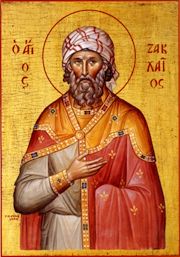
“Zacchaeus, make haste and come
down, for today I must stay
at your house”
You have heard, dear brothers and sisters,
the story of Zacchaeus many times. Being
so distinctive, it is known to all. Who was
Zacchaeus? What did he do? Today’s Gospel
tells us briefly: “He was a chief tax collector,
and he was rich. And he sought to see Jesus.”
We are told his profession: chief tax collector.
In other words, the one who collects revenue
– what we might call a ‘taxation officer’ here
in Australia.
However, this particular tax collector was
not satisfied with his wealth or his position.
He did not feel secure. Something was missing
for him. Something deeper and more lasting.
Something more spiritual. He had heard
of Christ. He heard that He was passing
through his neighbourhood, and “sought to
see Jesus”. He too wished to see Him, and listen
to Him. But “could not …for he was of
short stature”. He could not see over the
crowd because he was short. Even today,
when someone is physically short, we call
him ‘Zacchaeus’. This however did not stop
him from persevering. He therefore climbed
up a fig tree, so that he too could hear at least
some of Christ’s words.
 Christ sensed the thirst in his soul. He sensed his weakness in the spiritual realm
and had compassion on him, just as God who
knows all things, including the yearnings of
our heart, has compassion on each of us.
He had pity on him. And although the
crowd was so large, He said nothing about
the crowd. He did not dwell on the crowd,
but only on one person, one individual
specifically. On one who had spiritual thirst.
 He therefore cried out: “Zacchaeus, make
haste and come down”. This was not a request
to climb down, but to hurry down!
Make haste! “For today I must stay at your
house”. Today I must be with you.
These words are highly educational for us
all, dear brothers and sisters. To show us that
Christ does not just care for the world in a
general way, in an unspecified manner, as
when He allows the sun to shine for both the
good and the bad, or when He gives rain to
the righteous and the unrighteous. Rather,
the God of the living and of the dead cares
for each of us personally! Each of us becomes
a special object of His love, a special recipient
of His providence, when we sincerely bring
all our needs to Him. He overlooks no one.
He forgets no one. He is indifferent towards
no one. See how characteristically He tells
Zacchaeus that He must go and stay in his
house.
 The narrative thus far is no doubt interesting,
but it is not particularly moving. It could
have been any other famous person whom
the crowd wished to see and hear.
The account becomes especially educational from the moment we
notice the symbolism of certain simple, everyday events of life.
What does it mean that Zacchaeus climbed up a fig tree? And what
do the words “make haste, come down mean?” If we see these
events only on the surface, they are really quite trivial. The man
was short, he could not see Christ, then he climbed up a tree to do
so. Christ saw him. He saw his thirst, and said for him to come
down so that they could speak at his home.
The symbolism here is deep.
 The fact that Zacchaeus chose to
climb the tree shows that, whenever one is unable of one’s own accord
to accomplish something, it results in unease, ambition and
inventiveness. Then what? The person who is otherwise unable,
starts to be creative, uses a little cunning and finds a solution. A
lever could be used, or some other device. Did not the ancient
Greeks say ‘necessity is the mother of all invention’? When you do
not have the means, or when you are poor, you must find a way to
get by. And so with Zacchaeus who, being short by nature, sought
a device, and that device was the tree. He used it to be in a position
to see Christ.
 Yet Christ called him down! This is also very symbolic, for it is
as if He was saying: Listen here! Do not try and add foreign elements
to what nature has given you. Do not seek a crutch.
Crutches do not take you very far. You cannot have a tree everywhere
you go! So hurry and come down. The term κατάβηθι is
used here in the sense of ‘do not grow taller, do not ascend’.
In order to see Christ, one must descend. One must be humbled.
 If you are short, become even shorter in spiritual terms. Make
haste and come down! While you are still alive, while there is still
time, become humble, stay low, have your ears open. And Zacchaeus
then began to realize the meaning of Christ’s words, when he
declared: “Look, Lord, I give half of my goods to the poor, and if
I have taken anything from anyone by false accusation, I restore
fourfold”. If I stated that someone earns more than in actual fact,
and accused him in that way, I will return it fourfold. This was the
repentance of Zacchaeus!
 Clearly arising from his repentance is the spiritual meaning of
Christ’s words “Make haste, and come down!” He called him
down to humble him, and he truly did. He truly repented. It was
no longer a momentary possibility of seeing Christ from the tree,
but rather the permanent joy of receiving Him into his home, in his
own environment, in his family surrounds, to feel Christ as his
own, and embrace Him.
This is why today’s reading, which may seem bland at first
sight, is so moving. It is for every person to evaluate and take stock
of the road traveled up until the present. And to see where he or
she was at fault. Who among us has not been at fault at some
stage? Everyone of us has committed sins and trangressions and
misdemeanours in life. We are all struggling and tormented people who
seek the light, who live with relatively few spiritual means
at our disposal, and who are yet called to transform the material
into something spiritual. And, depending on the how great is the
thirst in our soul, we will find the mercy of God, which changes
poverty into wealth, and necessity into opportunity.
Let us all absorb the message of Christ’s encounter with Zacchaeus,
and come down from any fig tree that we may have
climbed. From any social or professional position we may have acquired,
from any success we may have sought in this world – to
descend, to hide behind nothing, to become little children once
again, as we were when we first came into the world, when we felt
that everything depends on the will and blessing of God.
 And then, God will not simply watch over us, not only look
upon us wherever we are, but will call us by our name to make
manifest our repentance. To accept Him into our own circumstances,
our own life, as well as our personal relationships and
aspirations. And then Christ will be our true life – life eternal.
Amen.

By Archbishop Stylianos of Australia, St Andrew’s Theological College – The first two decades (St Andrew’s Orthodox Press, Redfern, 2007), p. 127 -133.
